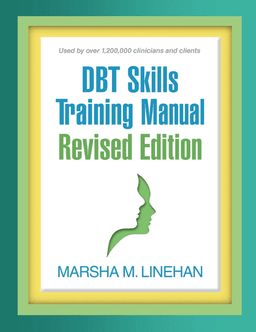
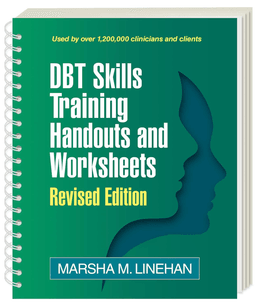
Marsha Linehan teaches
DBT Skills
Learn DBT Skills from the founder of Dialectical Behavior Therapy, with guidance from DBT expert trainers in a dedicated learning forum.
Learn DBT Skills from the founder of Dialectical Behavior Therapy, with guidance from DBT expert trainers in a dedicated learning forum.

Learn DBT skills directly from Dr. Marsha Linehan, the founder of Dialectical Behavior Therapy. Her teaching offers a rare and trusted perspective on how these life-changing skills were originally developed - and how to use them with purpose in your clinical work.
This training gives you a clear, practical foundation in the DBT skills that help clients build lives they experience as worth living. It covers the four core DBT skills modules, Mindfulness, Emotion Regulation, Interpersonal Effectiveness, and Distress Tolerance, giving you a strong foundation for real-world practice.
You don’t need to be a DBT therapist to use DBT skills. These skills can be used in a wide range of settings - and taught in ways that suit your clinical style and your clients’ needs, making them practical tools for everyday therapy.
Why Learn DBT Skills?
DBT skills were created to directly address the problems many clients struggle with most - emotional overwhelm, impulsive behavior, interpersonal conflict, and feeling stuck in suffering. These aren’t just therapeutic techniques - they’re life skills.
This course is led by Dr. Marsha Linehan, the creator of Dialectical Behavior Therapy. Her direct teaching offers rare insight into how DBT skills were developed and how to apply them.
You’ll also learn from internationally recognized DBT experts:
Alec Miller, DBT trainer and co-developer of DBT for adolescents and the DBT Skills in Schools program
Elizabeth Dexter-Mazza, DBT expert and co-author of DBT Skills in Schools
Together, with contributions from Jill Rathus, co-developer of DBT for adolescents, and Melanie Harned, developer of DBT for PTSD, they offer clinical wisdom and practical guidance from years of research, training, and real-world implementation.
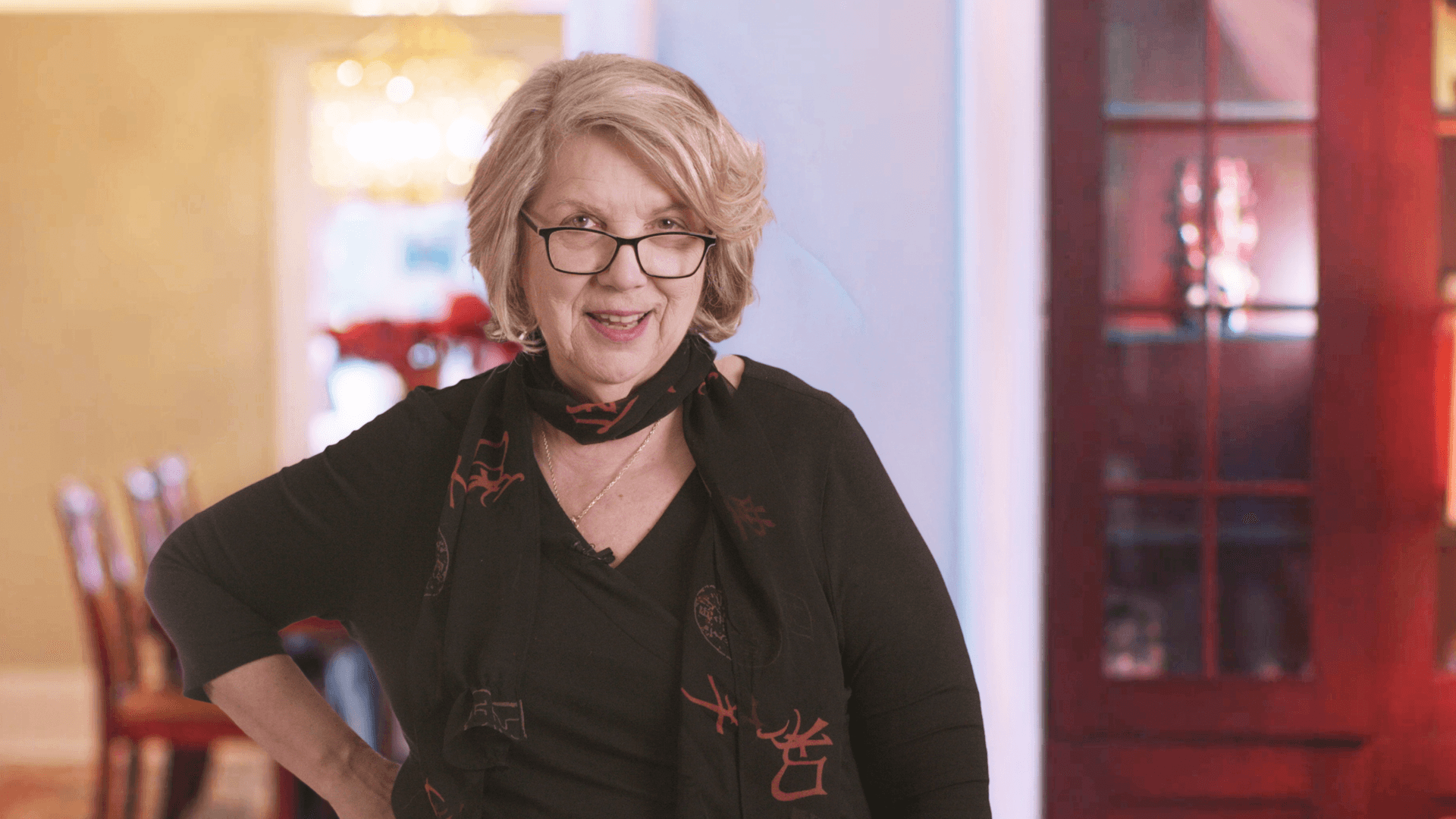
This training covers the four core DBT skills modules - Mindfulness, Emotion Regulation, Interpersonal Effectiveness, and Distress Tolerance. You’ll learn how each skill works, when to use it, and how to teach it in a way that’s engaging, focused, and clinically useful.
You’ll leave with:
A practical understanding of how to teach DBT skills in both individual and group settings
Strategies for weaving DBT skills into your current therapeutic approach, regardless of modality
Confidence to introduce skills flexibly or in full, depending on your client’s needs and support
Tools to support clients in developing greater stability, connection, and self-direction
Beautifully produced video lessons from Marsha Linehan and other DBT experts to guide your learning step by step
Therapy demonstrations showing how to teach and apply DBT skills in both individual and group sessions
Downloadable handouts and teaching tools to support your work with clients
An interactive forum to ask questions, share insights, and connect with expert trainers and peers
You don’t need to be DBT-certified to benefit from this training. The course is designed to be accessible, flexible, and immediately useful, regardless of your background or therapeutic orientation. If you're new to DBT Skills, Marsha Linehan explains more in this free resource: What Are DBT Skills? The Four Modules and How They Work.
Enrollments
We're happy to help if you can't attend the current intake. Please contact our customer service once your purchase is finalized, and we can enroll you in the intake of your choice. If you need an invoice, please fill out the form here.
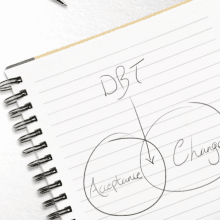
We begin by welcoming you to DBT Skills, introducing your main presenter, Dr Marsha Linehan, and the first key concept - mindfulness

DBT Skills overview
This module covers teaching the skills module 4 - starting with mindfulness

We investigate Wise Mind

This module looks at starting with mindfulness

Quiz questions

We begin this week by looking at the WHAT Skills - Observe, the beginning and essential skill of mindfulness

We continue and explore the WHAT skills essential for effective mindfulness: Describe

This module continues WHAT skills of mindfulness: participate

We continue exploring mindfulness and look at the HOW skills: Non-judgmentally

We continue and learn another HOW skill of mindfulness: One-Mindfully

This module continues to explore the HOW skills: being effective in mindfulness practice
Mindfulness wrap up and quiz questions

We begin week 3 by introducing emotional regulation skills

This module looks at understanding emotions.

We explore observing, describing and naming emotions in this module

This module delves into the mindfulness of current emotions
Weekly summary and quiz questions

We begin this week by delving into checking the facts when regulating emotions

This module continues by exploring opposite action when regulating emotions

Problem solving is the next skill we investigate when regulating emotions

We look at the problem solving skill in this module

This module investigates the A in ABC - Accumulating positives

We look at the B in ABC - Building mastery

This module looks at the C in ABC - Cope ahead

This module delves into the PLEASE skill
Summary of emotion regulation and quiz questions

We begin week 5 by introducing interpersonal effectiveness

The DEAR MAN skill

The GIVE skill

The FAST skill

This module investigates evaluating options as an aspect of interpersonal effectiveness

Summary of interpersonal effectiveness
Quiz questions

We begin by introducing distress tolerance

The module delves into crisis survival skills: part 1

The module delves into crisis survival skills: part 1

Understanding how to improve the moment is the focus of this module

This module covers reality acceptance skills: part 1

We continue by exploring reality acceptance - part 2
Quiz questions and course wrap up
Catharine PayzePsychologist - Perth Western Australia, AustraliaI just love Marsha's videos. They are engaging and hugely informative. The text is also clear and consise. This makes for a great introduction to the DBT skills. I find the incorporation of these skills in my practice meaningful and I can see my clients already beginning to benefit from our using them. Personally I am having a delightful time practicing the skills and seeing how effective they are.
Janice DaciukPsychotherapist - Grimsby, ON, CanadaIt's a great overview of how Dr. Linehan has broken everything down into such small parts such as the 10 emotion regulation handouts that are incredibly comprehensive. I don't have to reinvent the wheel.
Michelle SellsSocial Worker - Bothell, WA, USAI have fallen in love with DBT. I did not know what to expect in this training and I feel like I found a place I belong. I enjoyed Marsha's videos and the animation, the vacillation between the different teaching styles. This is absolutely a good experience and I found lots of new tools to bring into therapy with me.
Katie HaydenPsychologist - Auckland, New ZealandI like the clear way Marsha explains things and repeats things to reinforce my learning. I'm learning how to tackle tricky topics with people, and seeing the value of these skills for myself and my clients. I like the videos and visuals and I also like the group and individual therapy examples.
Frida FalkPsychiatrist - SwedenI've learned so much from the person who actually invented and thought through the whole therapy. So intelligent and clear. I'm a fan :)
Nathan TrimblePsychologist - NSW, AustraliaShort, snappy, visually-dense videos are helpful for learning. It has been the clearest explanation of DBT I have experienced. Also, the content itself is so useful for the population I serve - traumatised young people.
DBT Skills is designed for mental health professionals, health professionals and coaches worldwide. On completion you'll receive an official certificate of completion, which can be submitted to registration bodies for CPD.
This course is accredited for 15 CE/CME credit hours for US licensed professionals:
Psychologists - 15 CE hours, APA, co-sponsored with Amedco, an APA-approved sponsor
Social workers - 15 general CE credits, ASWB ACE
Physicians - 15 AMA PRA Category 1 Credits™, ACCME
Nurses - 15 contact hours, ANCC
Counselors, MFTs & addiction professionals - 15 hours, accepted by most US state boards via APA and ASWB ACE credit - see the state-by-state list
Approved CE activity with the New York State boards for Psychology, Social Work, Mental Health Counseling, and Marriage & Family Therapy.
View the full learner notification for this course (PDF) — includes complete accreditation statements, state board acceptance lists, learning objectives and faculty disclosures.
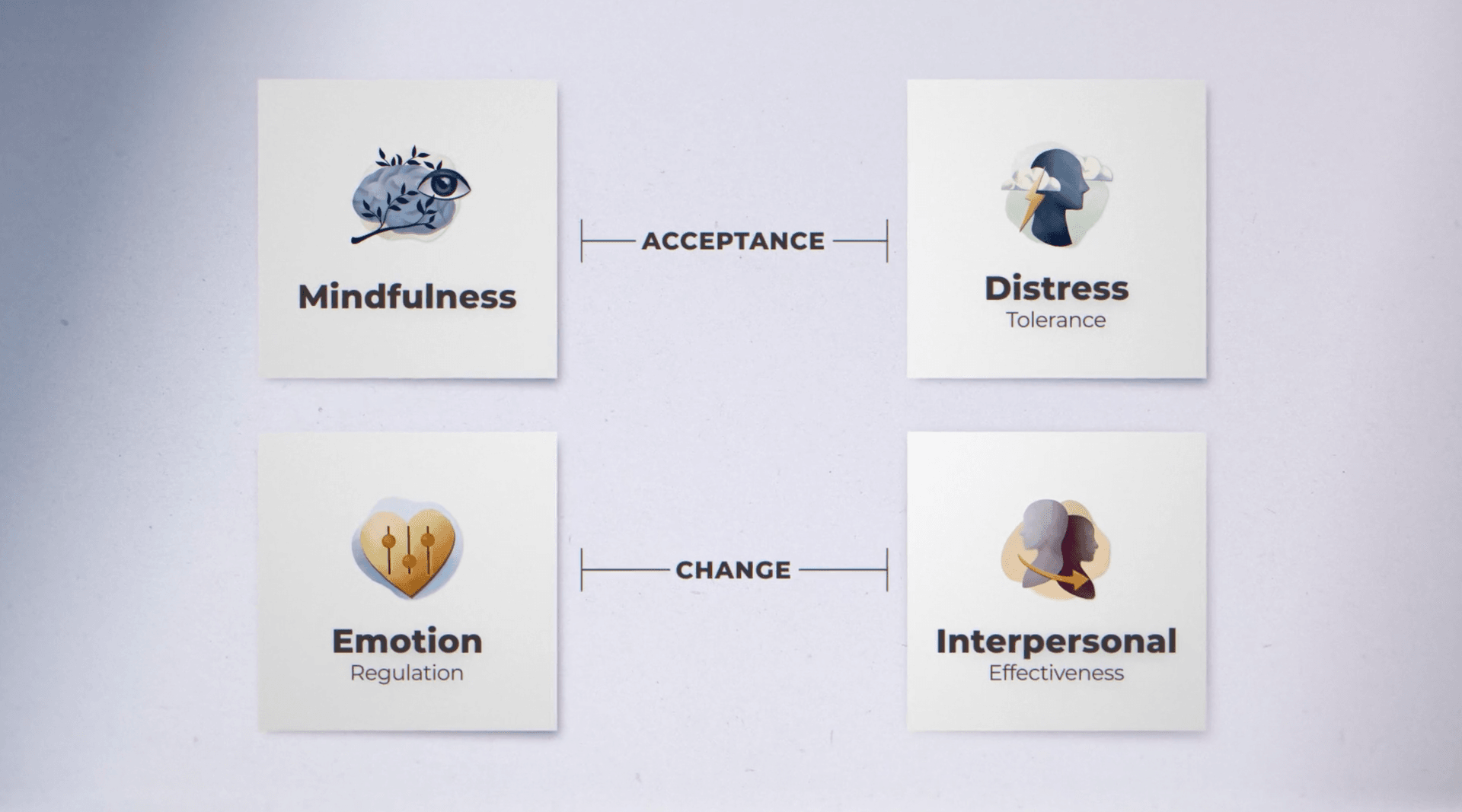
No. This course is an ideal starting point if you’re new to DBT. It focuses on the core skills—Mindfulness, Emotion Regulation, Interpersonal Effectiveness, and Distress Tolerance—which you can integrate into your existing clinical work or use within a full DBT program. It is also helpful for experienced DBT clinicians who want to refresh their skills and strengthen their understanding of how skills training supports effective treatment.
This course focuses on the core DBT skills themselves. You’ll learn how to teach and use Mindfulness, Emotion Regulation, Interpersonal Effectiveness, and Distress Tolerance with clients. It does not cover the full DBT treatment model, including the structure, modes, or protocols required for comprehensive DBT. It’s a helpful place to begin if you’re new to DBT or want to incorporate DBT-informed skills into your existing clinical work.
DBT skills help clients who experience intense emotions or impulsive behaviours, and they’re widely used for challenges such as emotional overwhelm, depression and anxiety symptoms, shame, anger, and relationship conflict. These skills give clients practical ways to manage emotions, tolerate distress, and communicate more effectively.
Yes. DBT skills can be integrated with a range of therapeutic approaches. You can incorporate mindfulness, emotion regulation, distress tolerance, and interpersonal effectiveness strategies into CBT, ACT, or other frameworks to support clients in managing emotions and engaging more effectively in the work. These skills complement your existing approach by helping clients stay present, regulate emotions, and respond more effectively in the moment.
You’ll learn the four core DBT skills modules—Mindfulness, Emotion Regulation, Interpersonal Effectiveness, and Distress Tolerance—and how to teach and use them confidently with clients. The course takes you deeper into the theory and research behind each skill and shows you how to apply them flexibly in both individual and group settings.
Through expert teaching, role plays, and therapy demonstrations, you’ll see how DBT skills support clients in building lives they experience as worth living. You’ll also be guided in developing your own voice and style in teaching and integrating these skills into your work.
This course offers a downloadable Certificate of Completion you can use to show your professional development boards. CE/CME credits are also available for completing this course - please check the learner notification to view the relevant accrediting bodies.