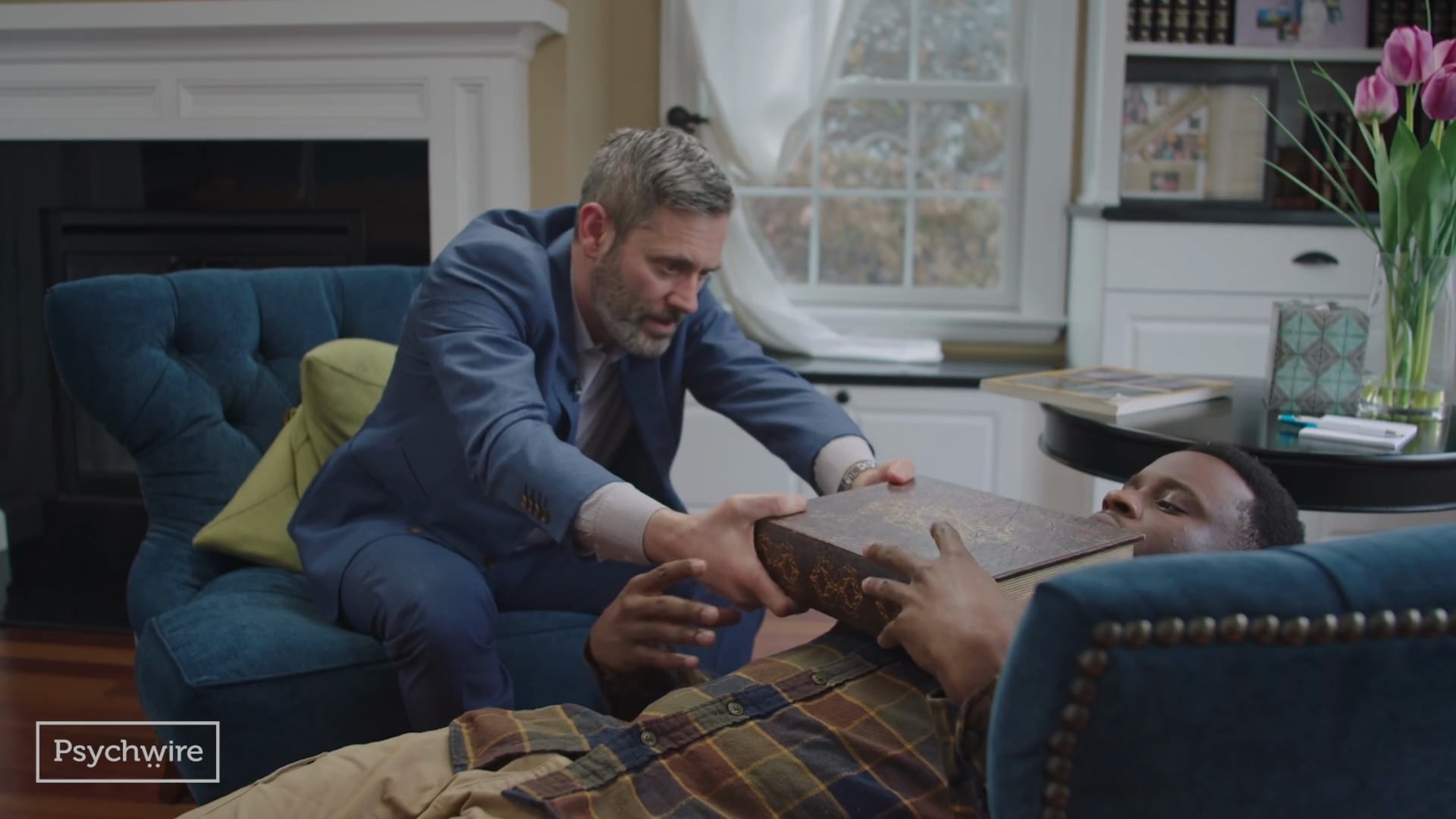

Alright. So we're gonna go ahead and do this. And what I'm gonna do is I'm gonna we'll start with one book And see how it feels, and then you tell me if you wanna move to the second book. Okay? And I think that'll probably be it. I have three here, but we'll just I think two will be plenty. Okay. And we'll see how that feels. Okay? Alright. And just just to let you know, you can stop whenever you need to stop, okay? If you if it feels like too much or you wanna stop, just tell me.
Or you could just take the books off or just tell me and I'll take the books off. Alright. Okay? Yeah. So let's go ahead and do that. And I'm gonna ask you for two ratings. The first is how similar is it to what you experience normally with your emotion, okay? And that feeling you described to me, that feeling of heaviness, right?
Okay. And then the second one is distress. We're gonna use a zero to ten on these. So I'm gonna ask you to gauge how distressing it is to you. Okay. Okay? Alright. Alright. So go ahead and lie down and you good? Yeah. Okay. So we'll start with the first one. Okay. Alright.
Let's let's start with that. Alright. So, what are you what are you feeling there? What are the sensations? It's not it's not too bad. I was like, I can feel something. I feel like there's a weight on me. Okay. It's like in addition to the weight that's I'm feeling inside, but it's not like not like something I can't handle. It's not like it's hurting me or anything like that. How how similar is that to what you normally experience in terms of that heaviness?
Like, is it similar to that feeling of heaviness that you have? It's not it's not similar. I mean, it's it's it's kinda close to, but it's not I wouldn't say they are the same. Okay. And how how much distress does this cause? I would say around like, maybe like, four. Okay. Four. Moderate, maybe less than moderate distress. Okay.
Do you think that if we moved up to a second book, would that, is that worth trying? Yeah. I'll try it. Yeah? Yeah. Okay. It seems like the distress is pretty good. I mean, it's not too high. But I'm trying to get it a little closer to what you feel. Okay. So maybe we could try a second book, see how that feels.
Okay. Okay. So let's try that. Alright. Okay. Difference there? Yeah. I definitely feel feel this one. I don't really like it as much. Is that closer to what you feel? It's it's definitely it it reminds me of what I'm feeling inside with the weight. Can you actually take it off? Yeah. Yeah. Yeah. Yeah. Okay. Hang on.
You want me to take this that one off too? Yeah. Okay. Alright. I gotcha. I gotcha. Thank you. Okay. That's alright. Sorry about that. No. No. No. No. That's fine. Where did the distress get to on that? I think it just it immediately rose to, like, around a seven.
Okay. Alright. It was just it was just reminding me too much of the feeling that I feel was, like, all over. I don't really have too much feelings in my chest but it's a feeling all over and I just didn't like Yeah. To be reminded of that. That that upsets you to have that? To have that. Like, just to know something's on me feels like I can't move with it.
Okay. And how similar was that feeling with the two books to what you normally feel? It was pretty, it was damn near, pretty close Okay. To it. I would say really close Okay. In comparison. Okay. Alright. Alright. And that that may have been why you were so distressed. Yeah. Yeah. Okay. Alright. I sort of feel like we should do this again.
Okay. Okay? Before we before we end today. I wanna do it for a period of time to where you get to a place where you feel a little more comfortable with it in that situation. Let's say we get the distress up to say maybe a seven or something like that. Maybe we can try to sit with it until we can get a reduction there. Maybe down to like a three or four. And then we can stop for for that particular exercise, Okay?
Okay. Because that's how I'd like you to do it when you're off doing it as homework. Okay? Over the course of the next week or so. Like, I'd like you to to try to do it and till you get used to it. And again, totally in line with the idea of tolerating And the idea of that is so that you can say, it can be there and I'm gonna do what I need to do. Alright. Okay? Okay. So let's give it another shot. Now, just try to notice that feeling of heaviness.
Try to notice any judgments you have about it. Okay? I know it taps into this this other feeling which is a bit more broad, you know, about your life and that type of thing. That's okay. That's what's coming up. Does it feel as bad as it did when we stopped the last time? No. Okay. What is the feeling? I mean, at first when you're putting it back on again, it's like The heaviness? Like a little heavy but So with that, I'm just I know that I can, like I don't wanna say take it off because I know it's supposed to be, like, I'm moving with it, but I feel like I can it's not as heavy As it once was.
Think in my mind I was making it a bit heavier than than it is. Okay. Okay. How you were thinking about it? Yeah. Yeah. It's not as heavy and I can can move with it. Does that feel like the right level? Does that feel like the right level of heaviness? I do think it's not as heavy as I feel. But I don't know if that's, like, something that's not making it heavier in my mind.
So I'm trying to see if or tap into if it if they compare, but I think it's still it's still something that's heavy. So Good. It's fulfilling its purpose in a sense. Okay. Good. It's fine. Just notice those feelings. Okay? That's all you gotta do. How much stress did you feel when it first started? Like a zero to ten.
I guess seven and a half just having to go through it again. Yeah. Yeah. Yeah. It's definitely went down now. Okay. Where are you at now? Yeah. Like a three. Okay. Let's go a little bit longer. Okay. I think that's good. Okay? So I'm gonna take it off now. It's like you got it?
Yeah. K. Alright. Go ahead and take a seat. Alright. Good job. Alright. So how was that different the second time compared to the first? At first, I just I thought it was heavy and I thought it was heavy even though I don't think it was as heavy Yeah. As what I was feeling. It made it seem like it was much heavier than because I just I just didn't wanna sit with it, to be quite honest. I didn't really wanna do it.
But now, going into it and having done it and just sitting with it as opposed to just like, okay, you need calm down, just it's not as heavy as you're thinking it is. Right. Just chill and calm down. I was able to basically realize this is not as heavy as I thought it was or as I perceived it to be. Right. That's a good point. And it's that idea of how much of it is the actual physical feeling, right, like a weight or like a pressure or something like that Yeah. Versus it's heavy, it's heavy, it's heavy. Right? Because we can say to ourselves like, God, that's heavy.
When really what we're describing is more of a pressure. Yeah. Right? And it sounds like you were trying to take some of that component out of it. Know, the idea that in your mind it was heavy instead focusing more on what does that pressure feel like? Yeah. You know? In terms of the distress, where did it get to at the end?
I think I got to around like a one. Really? Okay. So it came down quite a bit. Yeah. Just it at first it was just like, this is on my chest again. Right. It's heavy. I have to do this exercise again. And then when you just told me just like, just keep sitting with this and when I sat with it, that's when I was like, oh. And it went down and now I'm like, I'm not thinking in my head, oh, you're feeling it.
It's not heavy. Yeah. Yeah. It's actually not as heavy as you thought it was. So that made me like, okay, this is fine. Great. Like, you know what I mean? Yeah. Yeah. Yeah. Now I'm just like kinda chilling. Yeah. That's it. No. That's it. That's perfect. That's great. That's perfect.
Excellent.