
I've just finished a long discussion with Amy about the idea of whether the emotion she's experiencing fits the facts of the situation. And that's one of the goals in using the check the facts skill. Where we're getting at is that when we go through the process of checking the facts, we may find that indeed the emotion really is justified and really does fit the facts of the situation. In that case, we might have a problem on our hands to solve which lends itself to a problem solving exercise.
On the other hand, when we find that the emotion isn't quite justified, meaning it doesn't fit the facts, we may not have the problem that we thought we had and we may want to work to change or reduce the emotion by using the skill of acting opposite to the emotion based urges. In this case, we've determined that Amy's predictions about not having a good time with her friends or some thoughts her friends might be having don't really likely fit the facts. And we also discovered that in some sense her low depressed mood doesn't fit the facts. Now what do we mean by this? There's two main ways a mood or emotion might fit the facts.
One is, is the emotion justified? Meaning does it fit the facts of a situation given the life context? In that sense, yes, Amy has a lot of problems and has gone through a painful divorce and her sadness about it, as well as her other problems and stressors absolutely makes sense and is justified. But there's a second way that the emotion may not fit the facts And that is if the emotion or mood has lasted too long and too intensely is not serving any useful purpose at this point and is interfering in the client's life in a way that the client wants to change the emotion. And it is in that sense that the emotion of sadness and low depressed mood doesn't fit the facts because Amy herself says this has been going on way too long. It's way too intense and it is interfering with every part of my life and I really want to work to reduce it.
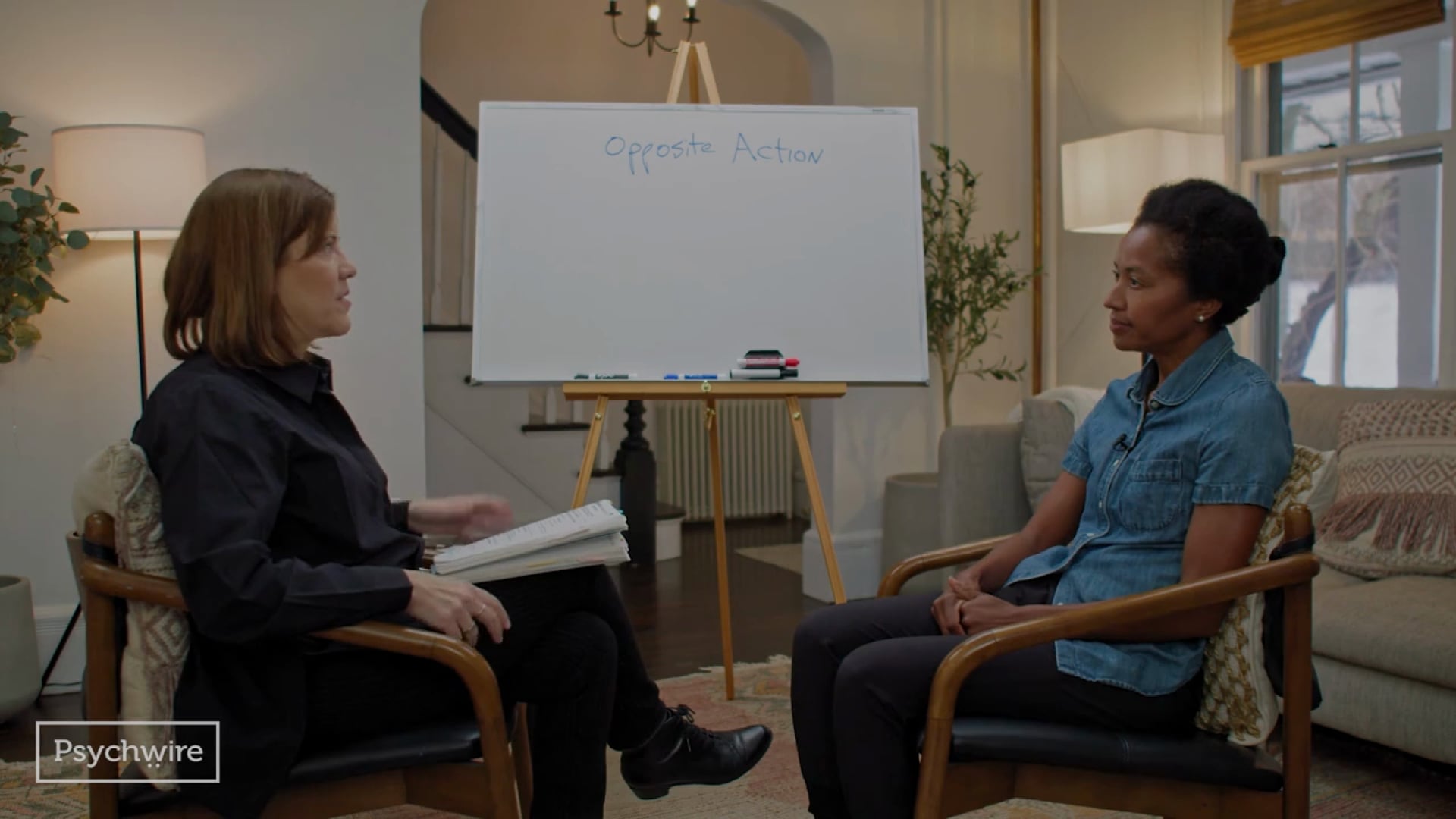
Because we determine in that sense the emotion doesn't fit the facts, we're going to now embark on using the skill of acting opposite to the depressed emotion urge of withdrawing and isolating and staying passive and inactive. So there's several steps and we can go over what the different steps are. The first step is we're going to identify and name the emotion that you want to change. So in this case, the emotion that we want to change is Sassess.
Sassess, exactly. So sadness is the emotion. The second step is check the facts to see if the emotion is justified by the facts. And that's a process we already went through together, where we looked at the thoughts and we examined them and we checked out whether the emotion really fits the facts. And let me write this down. Step two, check the facts. And after we went through the process of checking the facts, we found that you said, in this case, the emotion isn't justified because it's lasted too long and it's too intense. Yeah. I wanna clarify. Your sadness is absolutely valid and makes a ton of sense.
It's just that for you it's taken over too much of your life and you're ready to change it. You're ready to reduce it, right? Yeah. Okay. So, you wanna read step three there. Identify and describe your action urges. Right. So, let's take a specific situation. We're gonna identify the action urges. And let's take the situation of your friends calling you to go out dancing and for all the thoughts we discussed, your urge is to just isolate and stay home.
Alright? So your urge when you're sad is to isolate and stay Stay in bed. Even stay in bed and kind of be passive rather than active. Right? Okay. And then would you read step four for me right there? Ask wise mind. Is expression or acting on this emotion affected in this situation? Okay. So you're gonna ask yourself in your wisest place, your wisest mind, is acting on the emotion effective in this situation?
And based on what we've discussed, you're saying, what's the answer to that question? No. No, it's not effective, it's not working for you anymore. Okay, that wise mind says, no, it's not. Exactly. And then would you read step five? Identify opposite actions to your action urges. Alright. So you're gonna identify opposite actions to the urges and as you said before, if the urge is to isolate and stay in bed, the opposite action would be to get out of bed and be social and be with your friends.
Right? Is that what you would agree is the opposite action Yeah. To the urge? Okay. Go out, have a good time. Yes. Go out and have fun going dancing. So I'm gonna add in dancing. Which if you think about it is really opposite to the depressive urges of staying in bed because dancing takes a lot of action and energy. Right. It does. And step number six, would you read that? Act opposite all the way to your action urges.
Okay, we're gonna act opposite all the way. Meaning you don't wanna do it a little bit or halfway, you wanna really act all the way opposite. And we're gonna demonstrate this together and I'll show you what that looks like. You'll see, okay? So act opposite all the way. I'm gonna just say no halfway. Okay. And then would you please read number seven, the last one?
Repeat acting opposite to your action urges until your emotion changes. Alright. Okay, that's just a statement to repeat it until you feel the emotion going down. Alright. So those are the seven steps to acting opposite, and we're gonna use it with a case of sadness. So let's walk through it.