Understanding Overthinking: Why Thinking More Doesn't Help
Why overthinking feels helpful, how it maintains distress, and what therapists can do to help.
Many clients come to therapy exhausted by their own thinking. They replay conversations, revisit mistakes, analyse their emotions, imagine future problems, and search for answers that never seem to arrive.
Overthinking often persists because it feels useful. Clients may believe that if they can just think about the problem a little longer, they will finally understand it, prevent something bad from happening, or feel better.
The problem is that overthinking rarely delivers what it promises. Instead of providing answers, it often amplifies doubt, worry, and emotional distress. What begins as an attempt to solve a problem can leave clients feeling more stuck than before.
This is what makes overthinking so difficult to recognise. It disguises itself as problem-solving while quietly maintaining distress.
In this Q&A, Jessamy Hibberd discusses how overthinking develops, the difference between productive reflection and rumination, the role of attention and expectations, and practical ways therapists can help clients step out of repetitive thinking cycles.
Overthinking is when our minds get stuck on certain thoughts and feelings, usually negative ones, and we can't stop thinking about them. They could be things such as worries, replaying events in our minds, or endlessly questioning why something has happened. It's normal to think things over, to revisit your past, or work through alternative options for a situation, but persistently dwelling on how you're feeling and your thoughts causes problems. When we get stuck overthinking – we do it when we’re in a negative mood. We trawl through any potential problem, past, present or future, it stops us moving forward, it amplifies problems and it leaves us feeling worse.
It's most likely overthinking when you are:
Preoccupied by something and keep coming back to it again and again.
In a bad mood, distressed or overwhelmed.
Jumping from topic to topic without a break.
Moving from something specific that's happened to a general feeling about yourself or your life.
Feeling worse rather than better as a result of thinking about an issue.
Worrying or becoming self-critical about the very fact that you're overthinking.
When I talk about overthinking, I’m thinking about worry and rumination. Worry tends to be future-focused, while rumination tends to be past-focused. These thinking types overlap, and so the treatment approach for dealing with worry and rumination is the same.
Thinking through problems is obviously not all bad. In fact, it's an evolved and adaptive response – the brain is always trying to understand the significance of events and keep us safe from danger. But there's a difference between thinking things through and becoming stuck. While self- reflection is important (there wouldn’t be much point in my job if it wasn’t!), when introspection goes awry and thoughts get stuck on repeat, it becomes a problem.
Reflection is helpful. It’s a way to notice something that is off and work through a detailed analysis to solve the problem and close the gap. Or, if we’re working towards a goal, it’s a way to ensure we are making progress and staying on the right path. This type of analytical thinking is brilliant when it’s concrete, which is when we think about a specific issue and problem- solve solutions with a focus on what’s happened and how to take action. This is productive reflection. Giving some time and energy to the problem allows you to think of a solution, helping you to move forward.
However, this type of thinking becomes problematic when we shift to abstract thinking – or unproductive thinking. Moving from what’s actually happened to overgeneralizations, imagined scenarios and unsolvable thoughts. The initial issue might be a mistake you’ve made, but from there you begin to generalize and think about the fact you always mess up, or that you’re no good at all. Before you know it, you’re thinking about the fact you’re a completely useless person.
In my book I outline the key differences. As you’ll see, overthinking is never helpful:
Reflection vs Overthinking
Reflection moves you forward; overthinking leaves you stuck.
Reflection increases your capacity and helps you feel better; overthinking steals your capacity and lowers your mood.
Reflection focuses on concrete issues you can act on; overthinking focuses on abstract problems that cannot be solved through thinking alone.
Reflection helps you unpack what has happened and refine your thinking; overthinking creates a doom spiral of negative thoughts.
Reflection helps you evaluate your capabilities and strengthen your ability to cope; overthinking interferes with problem-solving.
Reflection uses emotions as information and helps you identify what you need; overthinking keeps you going over the problem while losing sight of what you really need.
Reflection allows you to feel emotions and then let them pass; overthinking creates stories around emotions and prolongs emotional distress.
Reflection helps you consciously choose how you want your future to be; overthinking keeps you locked in automatic patterns of habitual thinking.
In my book I outline my five-step plan to break free from overthinking. Each step is filled with evidence-based strategies and case studies to bring the ideas alive, based on my experience as a clinical psychologist and the research in this area.
In a nutshell:
Notice the thought: Freedom comes from increasing your awareness, so you begin to recognise your repetitive thoughts and see them for what they are – overthinking.
Choose your response: Make an intentional choice not to overthink and instead choose a new, healthier response to boost your mood. Using mindfulness, directing your attention to pleasant or neutral activities or using the mind-body link.
Challenge your thinking: Remind yourself that thoughts aren't facts, there's always more than one perspective especially when it comes to overthinking.
Accept the reality of how life is: Once you release your expectations, you're free to enjoy things as they are, rather than as you think they should be.
Face your fears: Action is the antidote to overthinking. It's only when you face your fears that you can overcome them and actively disprove your thoughts.
Unlike problems like depression or panic, people are reluctant to give overthinking up. It's often seen as a useful coping strategy – that if we just think long enough, we'll uncover the answer, take control, feel better. But it has the opposite effect!
In my book I call it the problem that disguises itself as the solution. When we overthink, we are living through the very thing we are worried about or trying to avoid, or reliving the past hurts that made us feel so terrible. Again and again and again.
I've come to think of it as a faulty coping mechanism, developed in response to feeling vulnerable or exposed. It starts as a way to manage how you're feeling and to try to work things out, but instead it makes your problems mutate and grow. Worse still, it can become habitual, so it is triggered any time you're feeling bad.
It’s important to see that there is nothing useful about overthinking. Dr Susan Nolen-Hoeksema, a Yale professor who spent her career studying overthinking, called it the 'secret to unhappiness'. When you look at the research it's clear overthinking should come with a health warning! These are just a few of the highlights…
Leaves you feeling frequently overwhelmed, angry, sad, anxious, ashamed or guilty.
Makes your problems feel bigger and limits your ability to feel joy
Steals your time, energy and motivation.
Damages self-worth, confidence and self-esteem and makes you more likely to compare yourself negatively with others.
Contributes to the onset, maintenance and recurrence of multiple mental health problems, including depression, anxiety and eating disorders
Can lead to chronic stress and contributes to physical health changes… it can even lead to problems like heart disease, stomach ulcers and chronic pain.
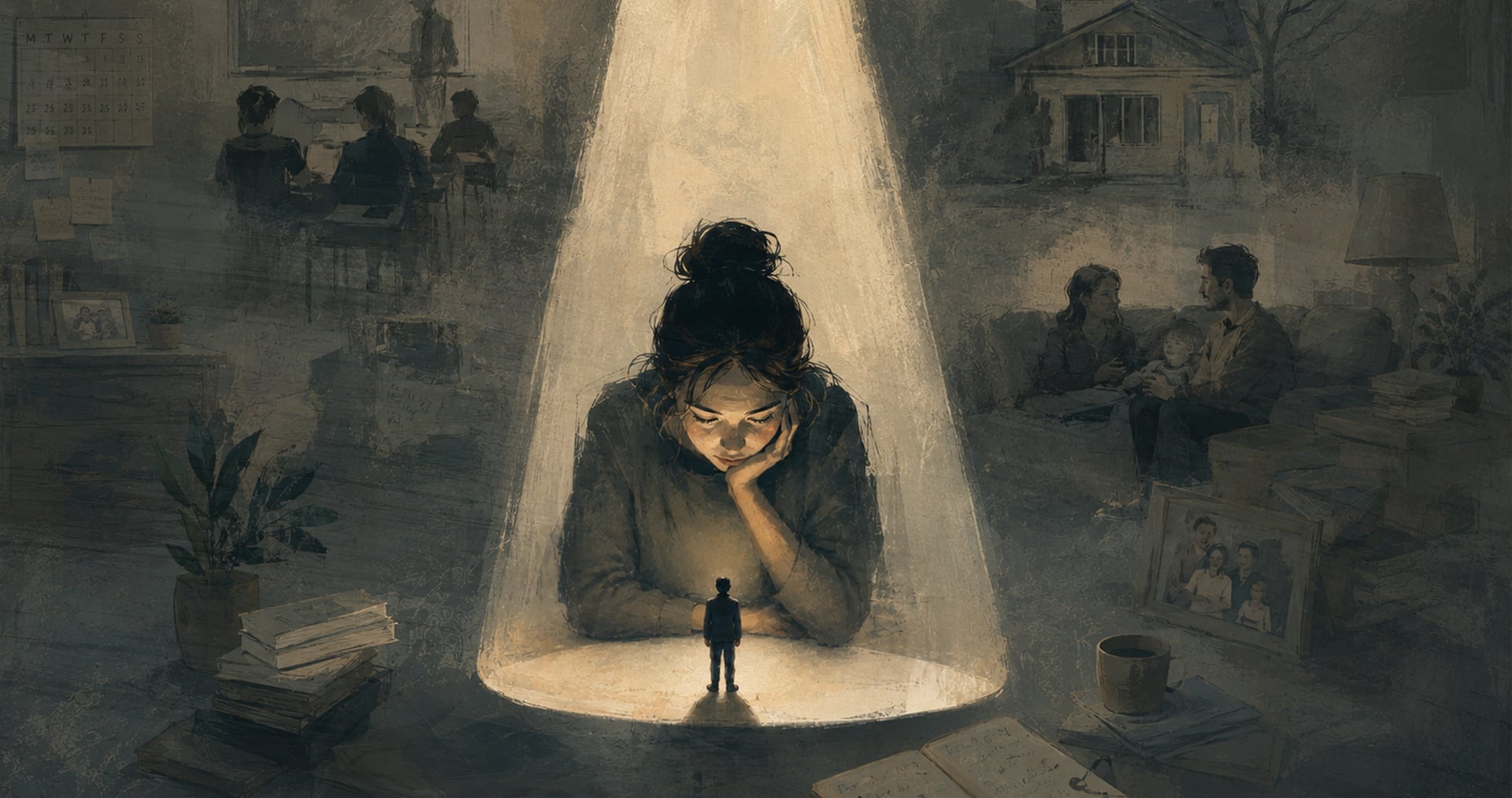
I’ve come to understand overthinking as a problem with your spotlight of attention.
Imagine you’re a lighting technician at a theatre, you control the spotlight and what the audience sees. You can use a broad beam and light the whole stage and all the actors or narrow the beam to just one person. Now imagine your mind is the stage and the spotlight is your attention. What you choose to focus on becomes your experience of life.
When we’re overthinking, it’s as if our spotlight has got stuck, fixed on one small detail, casting the rest of our life into darkness. We only see the problem. We notice the things that fit with our view and any counter ideas fall out of awareness. It shifts our focus of attention to all that’s wrong in our lives and when we fixate on one part of our life, it starts to look like the whole truth. Our overthinking mind changes what we see, but unlike the lighting technician, we don’t see it as a stage or one part of our life, we see it as the truth of our life at that moment in time.
Negative emotions narrow our attention and bring a negative bias, limiting our ability to be open to new ideas, other people, narrowing range of options, reduce problem solve. Positive emotions broaden our attention – efficient, flexible, creative, open to info, better at integrating, come up with a greater range of thoughts and solutions
The first rule to put into place is never think about things when you’re feeling bad - it’s like digging to get out of a hole. You can’t think your way out of a negative feeling.
The greater your awareness of this problem, the greater your chance of making changes and getting rid of overthinking for good. When you notice the thoughts (step one), it changes it from something that’s happening automatically to something you can choose to change
Step two is to then shift your mood first - once your mood is higher you’re in the best place to come back to the issue if it still feels pressing. This puts you in the best position to tackle whatever you’re going through.
Our expectations – how we believe we should feel, how we think the world works and the outcomes we expect – are at the root of much of our overthinking.
When we overthink we focus on the gap between where we feel we are and where we think we should be. I call this the expectation gap. We might ask ourselves 'why am I feeling like this?' or 'why did this problem happen?'. This is the first and biggest mistake overthinkers make. You can't think your way out of a negative feeling… it's like digging to get out of a hole.
Focusing on the gap in these situations is actually one of the worst things you can do. These abstract questions do not have an answer. It just leaves you thinking about all the things you're unhappy with, leaving you feeling so much worse.
This type of analysis makes your mood worse and increases negative thinking pulling you into a doom spiral – when you're stuck in a negative mood state that spirals on a loop, out of control. Once you're in this spiral it's very hard to get out of, as the mood we're in changes how we see the world. This negative bias can trigger a cascade of negative memories and self-critical thoughts, as we dredge up past regrets and imagine future catastrophes. So the worse we feel, the worse our thinking becomes.
To close the expectation gap and truly let go of overthinking it’s important to accept the reality of how life is. If, for example, we think we’re responsible for life going well – that we should be perfect, or that things should never go wrong – then we’ll constantly be triggered into overthinking by these impossible standards you need to accept how things are. This is the key focus of step four. When you let go of unrealistic expectations, you will no longer be constantly disappointed. You can experience life for what it is and appreciate it without preconceived conditions in your head.